Process
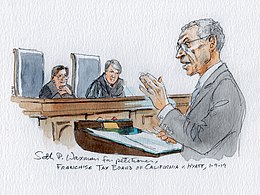
A term of the Supreme Court commences on the first Monday of each October, and continues until June or early July of the following year. Each term consists of alternating periods of around two weeks known as "sittings" and "recesses". Justices hear cases and deliver rulings during sittings; they discuss cases and write opinions during recesses.
Case selection
Nearly all cases come before the court by way of petitions for writs of certiorari, commonly referred to as "cert". The Court may review any case in the federal courts of appeals "by writ of certiorari granted upon the petition of any party to any civil or criminal case". The Court may only review "final judgments rendered by the highest court of a state in which a decision could be had" if those judgments involve a question of federal statutory or constitutional law. The party that appealed to the Court is the petitioner and the non-mover is the respondent. All case names before the Court are styled petitioner v. respondent, regardless of which party initiated the lawsuit in the trial court. For example, criminal prosecutions are brought in the name of the state and against an individual, as in State of Arizona v. Ernesto Miranda. If the defendant is convicted, and his conviction then is affirmed on appeal in the state supreme court, when he petitions for cert the name of the case becomes Miranda v. Arizona.
There are situations where the Court has original jurisdiction, such as when two states have a dispute against each other, or when there is a dispute between the United States and a state. In such instances, a case is filed with the Supreme Court directly. Examples of such cases include United States v. Texas, a case to determine whether a parcel of land belonged to the United States or to Texas, and Virginia v. Tennessee, a case turning on whether an incorrectly drawn boundary between two states can be changed by a state court, and whether the setting of the correct boundary requires Congressional approval. Although it has not happened since 1794 in the case of Georgia v. Brailsford, parties in an action at law in which the Supreme Court has original jurisdiction may request that a jury determine issues of fact. Georgia v. Brailsford remains the only case in which the court has empaneled a jury, in this case a special jury. Two other original jurisdiction cases involve colonial era borders and rights under navigable waters in New Jersey v. Delaware, and water rights between riparian states upstream of navigable waters in Kansas v. Colorado.
A cert petition is voted on at a session of the court called a conference. A conference is a private meeting of the nine Justices by themselves; the public and the Justices' clerks are excluded. The rule of four permits four of the nine justices to grant a writ of certiorari. If it is granted, the case proceeds to the briefing stage; otherwise, the case ends. Except in death penalty cases and other cases in which the Court orders briefing from the respondent, the respondent may, but is not required to, file a response to the cert petition.
The court grants a petition for cert only for "compelling reasons", spelled out in the court's Rule 10. Such reasons include:
- Resolving a conflict in the interpretation of a federal law or a provision of the federal Constitution
- Correcting an egregious departure from the accepted and usual course of judicial proceedings
- Resolving an important question of federal law, or to expressly review a decision of a lower court that conflicts directly with a previous decision of the Court.
When a conflict of interpretations arises from differing interpretations of the same law or constitutional provision issued by different federal circuit courts of appeals, lawyers call this situation a "circuit split". If the court votes to deny a cert petition, as it does in the vast majority of such petitions that come before it, it does so typically without comment. A denial of a cert petition is not a judgment on the merits of a case, and the decision of the lower court stands as the case's final ruling.
To manage the high volume of cert petitions received by the Court each year (of the more than 7,000 petitions the Court receives each year, it will usually request briefing and hear oral argument in 100 or fewer), the Court employs an internal case management tool known as the "cert pool". Currently, all justices except for Justices Alito and Gorsuch participate in the cert pool.
Oral argument
When the Court grants a cert petition, the case is set for oral argument. Both parties will file briefs on the merits of the case, as distinct from the reasons they may have argued for granting or denying the cert petition. With the consent of the parties or approval of the Court, amici curiae, or "friends of the court", may also file briefs. The Court holds two-week oral argument sessions each month from October through April. Each side has thirty minutes to present its argument (the Court may choose to give more time, though this is rare), and during that time, the Justices may interrupt the advocate and ask questions. The petitioner gives the first presentation, and may reserve some time to rebut the respondent's arguments after the respondent has concluded. Amici curiae may also present oral argument on behalf of one party if that party agrees. The Court advises counsel to assume that the Justices are familiar with and have read the briefs filed in a case.
Supreme Court bar
In order to plead before the court, an attorney must first be admitted to the court's bar. Approximately 4,000 lawyers join the bar each year. The bar contains an estimated 230,000 members. In reality, pleading is limited to several hundred attorneys. The rest join for a one-time fee of $200, earning the court about $750,000 annually. Attorneys can be admitted as either individuals or as groups. The group admission is held before the current justices of the Supreme Court, wherein the chief justice approves a motion to admit the new attorneys. Lawyers commonly apply for the cosmetic value of a certificate to display in their office or on their resume. They also receive access to better seating if they wish to attend an oral argument. Members of the Supreme Court Bar are also granted access to the collections of the Supreme Court Library.
Decision
At the conclusion of oral argument, the case is submitted for decision. Cases are decided by majority vote of the Justices. It is the Court's practice to issue decisions in all cases argued in a particular term by the end of that term. Within that term, however, the Court is under no obligation to release a decision within any set time after oral argument. At the conclusion of oral argument, the Justices retire to another conference at which the preliminary votes are tallied, and the most senior Justice in the majority assigns the initial draft of the Court's opinion to a Justice on his or her side. Drafts of the Court's opinion, as well as any concurring or dissenting opinions, circulate among the Justices until the Court is prepared to announce the judgment in a particular case. Since recording devices are banned inside the courtroom of the Supreme Court Building, the delivery of the decision to the media is done via paper copies and is known as the Running of the Interns.
It is possible that, through recusals or vacancies, the Court divides evenly on a case. If that occurs, then the decision of the court below is affirmed, but does not establish binding precedent. In effect, it results in a return to the status quo ante. For a case to be heard, there must be a quorum of at least six justices. If a quorum is not available to hear a case and a majority of qualified justices believes that the case cannot be heard and determined in the next term, then the judgment of the court below is affirmed as if the Court had been evenly divided. For cases brought to the Supreme Court by direct appeal from a United States District Court, the chief justice may order the case remanded to the appropriate U.S. Court of Appeals for a final decision there. This has only occurred once in U.S. history, in the case of United States v. Alcoa (1945).
Published opinions
The Court's opinions are published in three stages. First, a slip opinion is made available on the Court's web site and through other outlets. Next, several opinions and lists of the court's orders are bound together in paperback form, called a preliminary print of United States Reports, the official series of books in which the final version of the Court's opinions appears. About a year after the preliminary prints are issued, a final bound volume of U.S. Reports is issued. The individual volumes of U.S. Reports are numbered so that users may cite this set of reports (or a competing version published by another commercial legal publisher but containing parallel citations) to allow those who read their pleadings and other briefs to find the cases quickly and easily.
As of January 2019update, there are:
- Final bound volumes of U.S. Reports: 569 volumes, covering cases through June 13, 2013 (part of the October 2012 term).
- Slip opinions: 21 volumes (565–585 for 2011–2017 terms, three two-part volumes each), plus part 1 of volume 586 (2018 term).
As of March 2012update, the U.S. Reports have published a total of 30,161 Supreme Court opinions, covering the decisions handed down from February 1790 to March 2012.citation needed This figure does not reflect the number of cases the Court has taken up, as several cases can be addressed by a single opinion (see, for example, Parents v. Seattle, where Meredith v. Jefferson County Board of Education was also decided in the same opinion; by a similar logic, Miranda v. Arizona actually decided not only Miranda but also three other cases: Vignera v. New York, Westover v. United States, and California v. Stewart). A more unusual example is The Telephone Cases, which are a single set of interlinked opinions that take up the entire 126th volume of the U.S. Reports.
Opinions are also collected and published in two unofficial, parallel reporters: Supreme Court Reporter, published by West (now a part of Thomson Reuters), and United States Supreme Court Reports, Lawyers' Edition (simply known as Lawyers' Edition), published by LexisNexis. In court documents, legal periodicals and other legal media, case citations generally contain cites from each of the three reporters; for example, citation to Citizens United v. Federal Election Commission is presented as Citizens United v. Federal Election Com'n, 585 U.S. 50, 130 S. Ct. 876, 175 L. Ed. 2d 753 (2010), with "S. Ct." representing the Supreme Court Reporter, and "L. Ed." representing the Lawyers' Edition.
Citations to published opinions
Lawyers use an abbreviated format to cite cases, in the form "vol U.S. page, pin (year)", where vol is the volume number, page is the page number on which the opinion begins, and year is the year in which the case was decided. Optionally, pin is used to "pinpoint" to a specific page number within the opinion. For instance, the citation for Roe v. Wade is 410 U.S. 113 (1973), which means the case was decided in 1973 and appears on page 113 of volume 410 of U.S. Reports. For opinions or orders that have not yet been published in the preliminary print, the volume and page numbers may be replaced with "___".


Comments
Post a Comment